

 The Anticancer Lifestyle Team
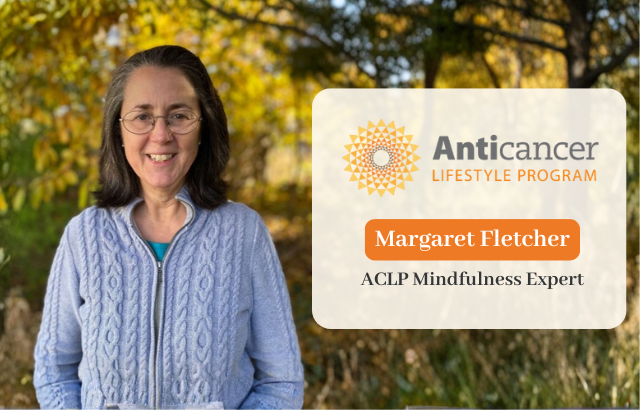
 How Margaret Fletcher traded spreadsheets for meditation and found her true calling in helping others heal.
Margaret laughs when she tells people how her mindfulness journey began: “It’s all my husband’s fault.”
Her husband, an “awareness guy” who had spent years reading deeply about Zen teachings and dharma, started passing along his carefully curated book list. What began as casual reading sparked something profound. Margaret found herself captivated by teachers’ accounts of meditation and practice—experiencing what she calls an “I’ll have what they’re having” effect.
Soon, she was exploring meditation and awareness practices at a local yoga community, diving deeper into a way of being that felt completely different from her successful career in the corporate world. Something was shifting inside her.
When Two Worlds Collide
In 2006, Margaret met a meditation teacher who would change everything. It was a significant step into a new way of being that wound up causing an ethical crisis concerning her corporate career.
The following year, a breast cancer diagnosis dropped into her life with jarring force. As she was recovering from surgery, she found out one of her doctors had made a note in her medical record: “Margaret seems to be in denial.”
The comment stopped her. Am I hiding something? Do I know what has just happened? Do I understand the situation?
But when Margaret checked in with herself, she found herself feeling unexpectedly peaceful. Her naturally sunny disposition and native optimism hadn’t disappeared in the face of cancer. If anything, the new awareness practices she’d developed had given her a stable foundation to cope with these new challenges. “I felt like the earth wasn’t done with me,” she recalled.
Not freaking out wasn’t denial. It was presence.
The Leap into Mindfulness
Her growing mindfulness practice and diagnosis crystallized something Margaret had already been feeling: a growing ethical crisis from working in a corporate world that she no longer wanted to be a part of. The insights she’d gained from mindfulness collided with her workday reality.
Margaret gave six months’ notice, banked enough money to live on, and made a decision to train as a mindfulness teacher. She enrolled at the Center for Mindfulness at UMass Medical School to learn to teach Mindfulness-Based Stress Reduction (MBSR), the evidence-based program that would become the foundation of her new professional life.
Margaret ended up teaching MBSR, as well as training others to teach, at UMass Medical School. Margaret now offers MBSR through East Coast Mindfulness, which she helped co-found in 2019.
Over the last two decades, Margaret has taught in corporate settings, small businesses, nonprofits, churches, and community organizations. She’s particularly passionate about working with cancer survivors through the Anticancer Lifestyle Program, where she serves as a founding member, featured teacher, and advisor. Having walked through cancer herself with mindfulness as her companion, she understands intimately what survivors face.
Over her many years of teaching mindfulness, Margaret has seen the protective, sustaining effects that the practice can bring to anyone who is willing to invest in awareness, self-understanding, and self-compassion.
So, Where Can You Start?
Margaret knows that many people feel intimidated by mindfulness. They think they can’t sit still, or that it requires hours of practice, or that it’s somehow out of reach.
She’s here to tell you: it’s not.
⭐️ Start with The Body Scan
Margaret calls the body scan “the queen of practices.” This foundational MBSR technique simply involves bringing gentle attention to different parts of your body, noticing sensations without judgment. You can find guided versions on YouTube or in mobile apps.
“The practice is evidence of your physical existence—that you are alive and well,” she explains. The practice doesn’t require any special equipment, flexibility, or ability to empty your mind. It’s really just about paying attention.
If you don’t have time for a full body scan, there’s a shorter version you can do right at your desk or dining room table. Simply feel your bottom on the chair. Notice the sensations of pressure. Focus your attention on one small sensation. That’s it. Concentration practice can be that simple.
⭐️ For the Anxious or Restless
If you have a difficult time sitting still, “there is always mindful movement—even mindful running,” Margaret notes. “Athletes have benefited greatly from learning and engaging in these practices.”
The key isn’t stillness—it’s paying attention. Walk mindfully. Run mindfully. Do yoga. The movement itself becomes the practice.
⭐️ Enrich Your Senses Outdoors
Margaret’s go-to recommendation: “Get outside every day.” A daily practice of simply going outside can enrich your senses. It’s important to be aware of what you are doing and of your surroundings. The earth itself is nourishment for our souls. Margaret suggests, “Watch the squirrels. Look at trees. Let nature work its ‘inner pharmacology.’”
Mindfulness as Foundation for Living and Lifestyle Change
For Margaret, mindfulness isn’t separate from the other lifestyle changes that reduce cancer risk—it’s the foundation that makes everything else possible. It can help you navigate conflict with greater ease. It can lift your mind out of fear when approaching medical visits or scans. It can provide a foundation for creating calm and healing, even when life feels at its most chaotic.
If you have come to the Anticancer Lifestyle Program to learn about changes that can reduce your risk of cancer or recurrence moving forward, you will find that mindfulness is deeply connected with the psychology of change. It can give you the capacity to navigate and stay with difficult changes long enough to find your way through.
For Anyone With “a Little Inkling”
Curious about mindfulness and the many benefits it brings? Margaret suggests exploring it as a practice, not just to feel calm and peaceful, but to help build resilience and be present for your life, whatever it may bring.
Two decades ago, Margaret gave up a financially secure career to dedicate her life to teaching others this powerful practice. It is of vital importance to her to spread the good word: that mindfulness is not mystical or out of reach, but is instead an evidence-based practice that can change lives.
“Really,” she insists, “it’s simpler than you think.”
Margaret continues to teach mindfulness in a variety of settings and serves on the Eco-Advisory Committee of the Bess Family Foundation, bringing mindfulness tools to address the climate crisis. She lives with her loves: the Earth, her family, her neighborhood, her gardens, all things fabric- and fiber-related, and the ongoing joy of helping people come alive.
⭐️ Start or restart your mindfulness journey with these resources.
Kickstart
eBooks
Webinars and Q&A
- Keeping Your Cool When Emotions Run Hot: Mindful Techniques for Managing Anger
- Mindset Q&A: Margaret Fletcher, Mindfulness Instructor
Blogs, Videos, Apps
Courses